20040529
=======
Big China on May 29, 2004 ……
China relations are better than they seem, says Lu
By Lin Chieh-yu, STAFF REPORTER
Vice President Annette Lu yesterday attempted to elaborate on the significance of President Chen Shui-bian's inauguration speech, saying a new kind of dialogue between leaders of Taiwan and China had been initiated and that Taiwanese should value this development.
"We should not focus only on tough words in the statements made by the Beijing authorities around the time of [our] inauguration," Lu said during an interview with the Central Broadcasting System (CBS).
Despite opposition claims that Beijing is nearing the limit of its patience with the Democratic Progressive Party government, Lu said that the cross-strait relationship has improved and that goodwill from both sides is on show.
"Those remarks, including the
statement issued on May 17 by China's state-run institute for journalism,
President Chen's inauguration speech and the official reaction from Beijing on
May 24 have offered some space for positive developments," Lu said.
"The Beijing authorities have always sounded off at Taiwan whenever we expressed our intention to march toward democracy and expand the country's visibility in the international community. This time they have demonstrated this in a manner more modest than ever before," she said.
"I would say that the leaders on both sides of the Strait have began an `air dialogue' and are creating bases for communication."
Lu also said that representing the president while visiting three of the nation's allies in Central America, as well as stopovers in the US, will show that the relationship with the US is on track.
"After President Chen pledged to carry out Taiwan's first referendum, some tensions were created both locally and overseas. Some people worried that such developments would affect Taiwan's situation and the US-Taiwan friendship. My visit to our allies and the short stopover in the US -- our best friend -- should indicate that we are now finally enjoying the coming of another spring," Lu said.
Lu has advocated a new "cross-strait" relationship between East Asia and the Americas and is hoping this trip will strengthen the bridge between Taiwan and countries on the other side of the Pacific.
"I would like to express my gratitude to the US government for supporting Taiwan joining the Organization of American States (OAS) as an observer," Lu said during her farewell speech at the airport. "I expect to return with concrete results facilitating Taiwan's bid to expand its international space."
-----------------------------------------
On May 29, 2004 ……
President Chen urges the EU to take an active role
By Lin Chieh-yu, STAFF REPORTER
President Chen Shui-bian yesterday urged the EU to play an active role in assisting Asian countries in developing democracy and peace, and to give stronger support to Taiwan's bid to participate in international organizations.
"We have realized that following the further integration and expansion of the EU, the union in the future will play a much more important role in international affairs, including in the Asia-Pacific region," Chen said when addressing the annual Europe Day dinner hosted by the European Chamber of Commerce Taipei (ECCT) yesterday.
Saying that the significance of the EU's integration inspired his inauguration speech on May 20, Chen said that the success of the EU, which was developing based on respect for the self-determination of individual countries, has structurally affected the principle of national sovereignty and challenged traditional notions of national boundaries.
Chen said that Taiwan values democracy, human rights and peace, which the EU also consistently values, for creating regional stability and development, and he expected the EU would contribute its experience and achievements to the Asia-Pacific region.
"I sincerely expect that members of the EU can enhance their role by facilitating democracy and human rights in Asian countries, ensuring peace in the Taiwan Strait and the Asia-Pacific, as well as giving more support in assisting the 23 million people of Taiwan in participating in international events and organizations," Chen said.
Chen also said he deeply regretted seeing the EU vote in opposition to Taiwan's eighth bid to join the World Health Organization (WHO) earlier this month.
"Taiwan has spent 12 years trying to become a member of the World Trade Organization [WTO]," Chen said.
"We hope that the EU in the future can be rid of political pressure and add its strong support to allow the 23 million people of Taiwan to enjoy the universal values of the WHO, including basic human rights and medical cooperation, hygiene and epidemic prevention with the rest of the world," Chen said.
The president congratulated the expansion of the EU into Eastern Europe by successfully inviting 10 more countries to join it, saying that Taiwan should grab such an opportunity to create not only commercial and technological cooperation but also diplomatic relations.
"While Taiwanese businessmen are endeavoring to march into all of Europe, we should encourage our business leaders to enhance their investment in Central and Eastern Europe to facilitate relations between Taiwan and those countries, especially in the fields of political, cultural and economic activities," Chen said.
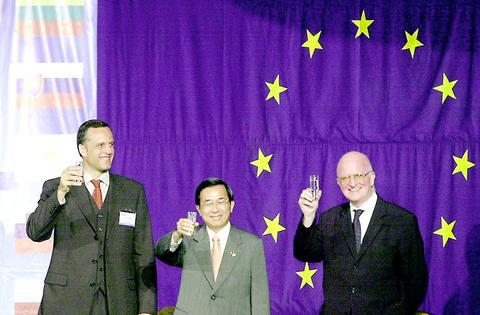
President Chen Shui-bian, center, European Chamber of Commerce Taipei Chairman Dirk Saenger, left, and European Economic Trade Office Director Brian McDonald drink a toast yesterday at a banquet held to celebrate the annual European Day.
-----------------------------------------
On May 29, 2004 ……
China clamps down for anniversary of Tiananmen atrocity
MONITORING: Police are monitoring campuses in Beijing and have placed a group of known dissidents under house arrest or strict surveillance
AFP , BEIJING
China's secretive state security police have set up a special task force to clamp down on students and political dissidents in the run-up to the 15th anniversary of the June 4 Tiananmen Square massacre, sources said yesterday.
"The universities are under strict control and there are several kinds of restrictions and regulations dealing with the anniversary," a Beijing academic said.
"For the universities, there is a special organ run by the State Security Ministry. They are responsible for a wide range of monitoring in the university district," said the academic, who has been warned not to speak with foreign media.
The 1989 massacre in the streets of Beijing killed hundreds, some say more than a thousand, unarmed students and citizens and has remained a highly sensitive topic, with students on the capital's campuses strongly discouraged from discussing the issue, he said.
"The students don't dare to speak about this because they know they will get in trouble. They can discuss these things in an abstract way, but specific discussion will only lead to trouble," the academic said.
While the security police are monitoring Beijing campuses, they have also placed a group of known dissidents under house arrest or strict surveillance.
The 70-year-old leader of the Tiananmen Mothers, Ding Zilin, whose son was killed in the 1989 massacre, has been put under surveillance and told not to accept visitors in the lead-up to the anniversary.
She is followed by police even when she leaves her home to buy food and daily necessities.
Ding's 15-year effort demanding the Chinese government give a full accounting of the massacre and find out who was responsible for ordering the military to fire on unarmed civilians has led to her nomination for this year's Nobel Peace Prize.
Other members of her grouping, like Huang Jinping, whose husband was shot and killed in the crackdown, are also facing similar police harassment.
Leading dissidents and social critics like Bao Tong, Liu Xiaobo, Hu Jia and Jiang Qisheng are all under police surveillance, they told reporters in recent days.
Their visits and meetings with others have been recorded and their phones tapped since the National People's Congress met in March.
"I don't think it is a very good idea to come and visit me right now," Liu said. "It's probably better to wait until after June 4."
The police harassment has been condemned by the US and human rights groups, who have blasted as ineffective new constitutional amendments adopted in March that aim to safeguard human rights.
"We oppose any efforts to limit freedom of speech and urge China not to restrict its citizens from engaging in debate on important and sensitive issues of public interest," US State Department spokesman Richard Boucher said on Thursday.
Boucher said Washington was particularly troubled by reports indicating that some actions had been taken to prevent Chinese citizens from meeting with US officials.
-----------------------------------------
On May 29, 2004 ……
China can learn from KMT's defeat
President Chen Shui-bian showed a positive approach to cross-strait relations in his May 20 inaugural speech, but China has not only rejected his goodwill, it has also sought to suppress democracy by various means in the name of acting against pro-independence movements, leading to a decline in democracy in China and Hong Kong and weakening democratic movements abroad.
China's Taiwan Affairs Office, in its battle against independence and democracy, claimed in a statement on May 17 that "if Taiwan's leaders should move to provoke major incidents of `Taiwanese independence,' the Chinese people will crush their schemes firmly and thoroughly at any cost."
In response to Chen's speech, Taiwan Affairs Office Spokesman Zhang Mingqing said on May 24 that "[Chen] is at the edge of the cliff right now." Although Chen's speech successfully deprived China of any excuse to attack Taiwan, Chinese Premier Wen Jiabao recently revealed that China is going to create a "unification law", which will serve as the legal basis for using military force against separatist movements. But unification is not something that can be achieved by wishful thinking on China's part. Calling it an "anti-separatist law" would probably tally better with reality.
Although it has been nearly seven years since Hong Kong's handover to China, the people of Hong Kong are increasingly displeased at its deteriorating economy, as well as Chief Executive Tung Chee-hwa's lack of achievement. Their discontent has grown into a full-blown democratic movement demanding direct elections. To curb the growing democratic movement in Hong Kong, Beijing has been airing an "anti-independence" message through pro-China media and academics. It has also singled out talkshow hosts, some of whom have been forced to resign in the interest of personal safety, causing the media to adopt a generally low profile.
Even more oddly, in the run-up to the 15th anniversary of the Tiananmen massacre, China's Department of National Security accused Taiwan of using overseas dissidents to collect information through family and friends in China, as well as helping to organize a Chinese opposition party abroad. There seem to be some inconsistencies in the timing, location and people involved, however. The directors of Taiwan's intelligence and cross-strait affairs agencies have denied these claims. This is clearly an attempt by Beijing to kill two birds with one stone: to attack overseas organizations of Chinese dissidents and tarnish Taiwan's image.
China's measures against independence and democracy are familiar to many people in Taiwan. During the period of Chinese Nationalist Party (KMT) rule, communists, advocates of Taiwanese independence and people "outside the party" were viewed as a "three-in-one" enemy. The KMT's high-pressure tactics forced many democracy advocates into exile. Although these hateful methods delayed the emergence of democracy in Taiwan, they also strengthened democratic ideology so that it was able to respond more powerfully when its time came.
The KMT, which seemed set to rule for 10,000 years, has now been pushed out of office through a popular election which placed the Democratic Progressive Party (DPP) in power in its stead.
China should study the path taken by Taiwan's democracy, which has become immune to tyrannical methods through its experience with the KMT. If China's senior government officials think they can continue to threaten their citizens in China and Hong Kong, they should take a look at what has happened to the KMT, to the former Soviet Union and Eastern Europe's communist regimes. The democratic spirit expressed in the phrase "the needs of the people are always in my mind," is the best way to deal with the threat of separatism.
-----------------------------------------
On May 29, 2004 ……
-----------------------------------------