20040530
=======
New Constitution on May 30, 2004 ……
Lee insists on a new constitution
OUT WITH THE OLD: Former president Lee Teng-hui says Taiwan needs to write a brand-new constitution, which should be created by holding a referendum
By Chang Yun-ping, STAFF REPORTER
Former president Lee Teng-hui yesterday criticized President Chen Shui-bian's plan to amend the Constitution and said it was a lie to the people of Taiwan. He insisted that the country need a referendum to create a brand-new constitution.
Addressing a gathering of the Association of Friends of Lee Teng-hui, Lee said that the country needs to create a new constitution rather than revising the existing one, which has been amended six times in the past.
`Impossible'
"It's impossible to revise the Constitution. I've revised it six times already," Lee said, referring to the six constitutional revisions carried out during his 12-year presidency.
However, advocating that the constitution should be made according to the people's wishes in a referendum, Lee said that the Referendum Law was a watered-down law which did nothing but limit people's rights to hold referendums.
He said that the most pressing matter now is to amend the Referendum Law, but this could only be achieved when the pan-green camp becomes the majority in the legislature after the year-end legislative elections.
Composition
"The existing composition of the pan-green and pan-blue lawmakers in the legislature makes it very difficult to amend the Referendum Law, which, if not amended, can't be used to create a new constitution.
"Chen's plan to elect an ad hoc national assembly or incorporate people's rights in the constitutional revision also can't overhaul the existing constitution satisfactorily," Lee said.
Responding to Chen's inauguration speech, Lee said it had to be conciliatory because Chen realized that his presidential victory was narrow and he had to take the other half of the electorate who didn't vote for him into consideration for the sake of social stability in the country.
"I can understand why Chen would say what he did in his inauguration speech because I was a president myself. It was because the difference in numbers between the pan-green and pan-blue supporters was too narrow, which poses the danger of Taiwan becoming unstable," Lee said.
Chen won a razor-thin election victory by only some 29,000 votes.
Lee said that Chen's narrow victory was the reason for the US opposing Taiwan in creating a new constitution, and "the US would have different opinions if Chen had won by more than 300,000 votes. That way the government would have had strong enough support to go ahead with creating a new constitution."
Drubbing
Commenting on the US' stance in
supporting Chen's constitutional amendment plan, Senior Presidential Advisor
Koo Kuan-min yesterday lambasted the US for interfering with Taiwan's plans to
draft a new constitution, saying he wants to organize "anti-America"
activities to protest the US' interference with Taiwan's internal affairs.
"Taiwan is not a colonial state
of the US. It can't stop its plan [to create a constitution] simply because the
US opposes it. Where is Taiwan's sovereignty then?" Koo said.
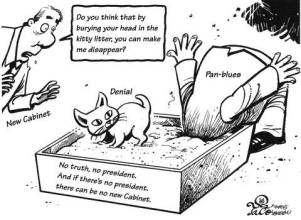
Commenting on the pan-blue alliance's moves to deny the election defeat and its insistence on overturning the election results, Lee said that Chinese Nationalist Party (KMT) Chairman Lien Chan looked like a psychiatric patient on March 20 after losing a depressing presidential-election battle. Lee urged Lien to give up his incessant pursuit of the country's top job.
"On March 20, Lien exposed his true self and some psychiatrists told me Lien's face looked just like that of a psychiatric patient. He claimed his contributions were for the sake of the country, but actually those were just his selfish pursuits.
"Lien was not predestined to become a president, but he wanted to sacrifice the country in order to fulfill his own desires. He should stop these vain pursuits," Lee said.
-----------------------------------------
On May 30, 2004 ……
Marines take on a series of uncertainties
SPOTLIGHT: The debate over the suggested deployment of Taiwan's Marines to Iraq has raised doubts about battle readiness in an environment unrelated to training schedules
By Jimmy Chuang, STAFF REPORTER
The proposal by US House Representatives, both Republicans, Dana Rohrabacher and Jim Ryun last weekend that Taiwan send its Marines to Iraq has placed the nation's Marine Corps in the spotlight -- even if the proposal is seemingly unworkable.
Pro-China legislators were among those most vehemently opposed to the idea.
"Whenever a country requests another country to dispatch its troops, the bottom line is that they must recognize each other as a country. Would this mean that, at this moment, the US recognizes Taiwan as a country instead of as part of China?" asked People First Party (PFP) Legislator Sun Ta-chien.
Retired Admiral Nelson Ku, now a PFP lawmaker, said that there was no reason for Taiwanese Marines to join operations in Iraq.
"`For whom' and `for what' are the bottom lines for the military in carrying out its missions," Ku said. "However, we cannot find any reasonable answers to these questions in regard to this issue."
Ku said that to join the alliance, Taiwanese troops would have to train with other troops so they could familiarize themselves with alliance tactics.
He also said it was very important to establish who would foot the bill.
"If coalition members don't pay, then the Taiwanese people will. However, I think it would be rather difficult to persuade Taiwanese to pay for all of this at this moment," Ku said. "We cannot fight for nothing. It is not our military's job to protect other countries."
Fearless
But Rohrabacher and Ryun's proposal at least brought a degree of international credibility to Taiwan's Marines, whose slogan is "Fearless of pain, hardship and death."
The nation has 39,000 Marines, based in Tsoying, Kaohsiung City. But most of this number is made up of conscripts completing their two-year compulsory military service.
The Marine Corps has four divisions -- infantry, armor, artillery and amphibious reconnaissance. Airborne and hovercraft divisions are also now under development.
In the infantry division, the Marines have a "security company" which is responsible for guarding naval bases and other functions normally assigned to military police.
The company also functions as a combat unit and is responsible for supporting air defense, counter-intelligence and other missions.
To become a marine, a recruit must attend a two-month boot camp in the corps' training center in Pingtung County. After that, the recruit is assigned to advanced training programs according to his or her abilities. The total amount of time spent on training is approximately six months.
In 2001 the Marines invited US military personnel to observe exercises. The US military officials complimented their Taiwanese counterparts, saying that parts of the training program were tougher than the US Marines' schedule.
Weapons
Taiwan's Marines are equipped with a wide range of weapons, including T-74 machine guns, XT-86 combat rifles, T-77 submachine guns, T-65 rifles, Colt 45mm pistols, 300 US M-60 A3 tanks, 200 US M-41 tanks, a total of 700 LVT armored vehicles, US V-150 and domestically built amphibious assault vehicles, US M-24 armored personnel carriers and LTH-6 carriers armed with 105mm cannons.
As to nautical hardware, the Marines boast 46 landing ships, 130 transportation craft and 210 armored landing craft. In addition, the navy's two Newport Class landing ships, leased from the US, allow the Marines to launch attacks 8km from shore. These ships can carry 420 Marines, 500 tonnes of vehicles, four small landing craft and two helicopters.
The Newport Class landing ship is also able to drop Marines and armored vehicles via a 100m-long retractable bridge or a 34m-long retractable bridge if the vessel has trouble docking during combat.
In addition to combat missions, the Marines also monitor airspace on behalf of the navy. The Marines can spot aircraft approaching bases from more than 30km away and can track 64 different objects at the same time.
Special forces
For years the Marines were renowned for their Amphibious Reconnaissance and Patrol Unit (ARPU) and Special Service Company (SSC). However, in October 1999, the SSC was brought under the ARPU's command.
Marines special force members, most of whom are Aboriginal, are career soldiers. A special force member must be between 170cm and 180cm in height, weigh between 60kg and 80kg, have an IQ of 110 or above and not need to wear glasses. In addition, the ARPU does not allow its member to sport tattoos.
The special forces' daily physical training regimen involves swimming in full combat gear and a lengthy run. In addition, every member is a qualified martial-arts practitioner who is also trained in special combat skills such as demolitions, lock-picking, scuba diving, combat tactics, weapons training and jump training.
At the same time, team members must have a basic knowledge of how to operate different modes of transport, including vehicles, aircraft and ships.
In addition to weapons used by the Marines, the ARPU is also equipped with Uzi submachine guns, M733 rifles, Glock 17 pistols, SSG-2000 sniper rifles, night-vision gear and GPS navigation systems.
Weakening?
However, attempts to change the military into a "high-tech" force led to reforms in basic physical training -- except for the ARPU -- which worries a number of people in the military.
"If the government decides to send our Marines to join the US in Iraq, it would suggest to me that the government really hasn't got any idea what's going on. Could our Marines survive in the desert? I really doubt it," retired Vice Admiral Lan Ning-li said.
Lan said that before 1991, the period of compulsory military service for those in the navy, air force or Marines was three years. Back in that era, he said, even retired Marines would be asked to march at least 70km during regular recalls.
"There is a school of thought that says these new, easier regulations are weakening our forces somewhat," Lan said. "That is why I am worried that our Marines may let us down if we send them to the battlefield now."
Lan said the real problem was that the Marines do not receive the attention they deserve.
"For instance, they do not have state-of-the-art weapons. Many of their weapons are actually leftovers from World War II," he said. "In addition, constant government cutbacks to marine numbers is making the problem go from bad to worse."
Responding to Lan's complaints, Marines headquarters said there was still a daily physical training program, including a 3km run, for all Marines, and that the reduced physical training did not make a significant difference to the force.
"Honor is the most important thing for soldiers, especially for Marines," said one senior marine at the headquarters, who wished to remain anonymous.
In the meantime, the officer said that the Marine Corps was also focusing on mental conditioning and training programs utilizing advanced technology.
"We need Marines who can work under pressure," the officer said. "In addition, we need everybody to know how to use a computer, because these days many weapons are guided by computers."
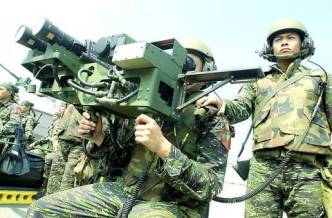
A Taiwan marine holds a dual-mounted Stinger anti-aircraft missile
during an exercise on Aug. 27, 2002.
-----------------------------------------
On May 30, 2004 ……
Principles come before alliances
The Chinese Nationalist Party's (KMT) Strategy and Discourse Unit has been meeting over the past week, intensively discussing the adoption of nativized concepts as the party's central ideology. Meanwhile, Ting Shou-chung, director of the KMT's Organization and Development Affairs Committee, claimed on Thursday that the proposed merger between the KMT and the People First Party (PFP) will be addressed soon. Evidently, the rivalry between the two KMT camps -- supporters of the conservative "Great China" ideology and those who back a nativized "Taiwan consciousness" -- is still very much alive.
Some of the topics raised and discussed by the Strategy and Discourse Unit are a pleasant surprise. The panel is co-chaired by two leading figures of the nativization camp, Deputy Chairman Vincent Siew and Wang Jin-pyng. The most impressive topic is the rejection of the "one China" ideology and the incorporation of some Taiwan independence concepts. This echoes Wang's statement before the presidential election that the KMT does not rule out the Taiwan independence option.
As for how that goal is to be accomplished, the KMT panel discussed various ideas. One was the idea of "diplomatic neutrality" by Taiwan; that is, for Taiwan to maintain an equal distance from both China and the US. However, as much as it may be an improvement over the party's current "Great China" dogma, "diplomatic neutrality" does not help the KMT circumvent the sovereignty issue. Is Taiwan a diplomatically neutral "country" or "region?" The most obvious answer is of course the former, but that would be going further than merely "not ruling out the possibility of Taiwan independence." If the answer is the latter, then the KMT would face the same ambiguity about the status of Taiwan.
Also worth noting was the panel's idea of an "independent Republic of China (ROC) on Taiwan, Penghu, Kinmen and Matsu," which was offered as a way to depict the status quo. This is no different from the "ROC on Taiwan" concept embraced by the KMT when former president Lee Teng-hui was the party's chairman. However since Lee's departure from the party the KMT has long discarded that concept. If this "same wine in a different bottle" could be swallowed again, then that would surely signify a return by the party to the nativized path that Lee laid the foundation for.
Members of the Strategy and Discourse Unit and the nativization faction in general are generally moderate and pragmatic. They clearly see that President Chen Shui-bian won re-election with a "Taiwan consciousness" campaign theme. They also realize that in order for their party to have a realistic chance of playing the role of a powerful opposition party, the nativization path is the only viable option.
However, these arguments have provoked a major backlash from the "Great China" ideologists within the party. One cannot help but feel skeptical about whether the Strategy and Discourse Unit's recommendations will be adopted by the party's Central Standing Committee.
It makes sense for the KMT to first reach a consensus on its core ideologies and its future path before making any substantive moves on its pro-posed merger with the PFP. After all, a political party is supposed to comprise people with similar political ideologies. Whether the merger should be carried out should depend on whether the two parties can agree on fundamental political ideologies. Thus any attempt to push for a merger in haste is not advisable.
-----------------------------------------
On May 30, 2004 ……
Merger plan promises a wedding soap opera
`To get amusement out of the political arena is like squeezing a flattened tube of toothpaste: you can rarely get anything out.'
By Chen Ro-jinn
At last, our politicians are going to give us a more entertaining show. Many political observers are treating the merger between the Chinese Nationalist Party (KMT) and the People First Party (PFP) as though it were a jubilant wedding.
People can cast aside their fear of a contagious "political depression" for a while and have a spree at the wedding party. They can pop in to the KMT's and PFP's houses and see how the bride and groom get through the wedding. It's a chance to have some fun! The entertainment value is high and chances like this are rare. To get amusement out of the political arena is like squeezing a flattened tube of toothpaste: you can rarely get anything out.
High-ranking officials in the KMT and PFP want to merge the parties, but grumbling sounds can be heard from the rank and file. Some PFP members have described the KMT as an ailing groom who wants a festive wedding to wash away bad luck. The KMT has retorted that the PFP has shown itself prone to extramarital affairs. In response, the PFP has taken exception to the KMT's party-assets scandals that a merger would embroil them in, leading the KMT to snipe back that the PFP behaves like a petty gossip complaining about the future brothers-in-law before marrying into a big family.
Even though they have nothing but contempt for each other, they still spruce themselves up to be married. A farce is about the begin as they set out upon the red carpet. The farce will make the audience burst into laughter and tears because of its absurdity.
Viewing this farce in a sensible light, we know an incompatible couple will make for a painful marriage. A Taiwanese slang phrase is "pissing on sand, you only pile up the stench." It might not be very refined, but it vividly portrays the two parties' current situation. How can urinating on a heap of sand help consolidate it? When the KMT and the PFP together spread speculations about vote-rigging and a "faked" shooting, their relationship presented a smooth surface.
Yet, after sand is mixed with reeking urine, not only does it not consolidate into a firm heap, but it also becomes scarred and pock-marked, and has a lot of little lumps. In the argument over the merger bill, a KMT internal force led by Taipei Mayor Ma Ying-jeou can no longer provide gracious support for KMT Chairman Lien Chan to lean on.
Other splinter groups in the KMT's localization faction have disliked the PFP from the start. Now the conflicts are out in the open. Even PFP Vice Chairman Chang Chao-hsiung swore never to convert to the KMT. So far, the greater the effort put into merging the parties, the further apart they seem to become.
If the KMT and the PFP fail to find a reliable cement to fortify their sand castle, they will repeat the folly of Japan's Liberal Democratic Party: a string of divorces and remarriages. Unlike Japan's LDP, the KMT and the PFP are facing a rapidly growing party that holds power. Perhaps, as a PFP legislator who wore sunglasses on the day of the merger announcement said, "it's getting dark."
Chen Ro-jinn is a freelance writer.
-----------------------------------------
On May 30, 2004 ……
Activist challenges China's `lies'
REMEMBRANCE: The leader of the Tiananmen Mothers group, who has been under strict house arrest since Tuesday, called the 1989 massacre a crime against humanity
AFP , BEIJING
A top Chinese political activist held under strict house arrest ahead of the Tiananmen Square massacre's 15th anniversary has urged the public to challenge the government's "lies and fraud" over the June 4 crackdown.
Nobel Peace Prize nominee Ding Zilin, 67, leader of the Tiananmen Mothers group, said in an unusually bold statement that Chinese people should dispute the Communist Party's view that the crackdown was needed to maintain stability and usher in a period of strong economic growth.
"We must now in equally clear and unequivocal terms tell these leaders: The massacre that took place in the Chinese capital in 1989 was a crime against the people, and a crime against humanity," Ding said on the website of the New York-based Human Rights in China (HRIC).
"This massacre not only seriously violated the Constitution of this country and the international obligations of a sovereign state, but also transformed a habitual disdain for human and civil rights into an unprecedented act of violence against humanity," she said.
Hundreds of people, perhaps more than a thousand, were mowed down in the streets of Beijing as the army used tanks and machine guns to end six weeks of student protests centered on Tiananmen square in the heart of the capital.
Ding, whose son died after being shot in the back during the bloody put-down of the pro-democracy demonstrations, said that she had been under house arrest since Tuesday.
"The police came to my home on May 25, they said that I cannot leave the home except to buy food, when several of them follow me to the market," she said by telephone.
"They had no legal documents and they could not cite which laws were being used to restrict my freedom of movement, they only said that the orders had come `from above.'"
Ding's Tiananmen Mothers group, made up of relatives of the massacre's 182 known victims, has waged a largely fruitless campaign to seek redress from the government.
The movement has collected vast documentation and pictures of the crackdown and called on the government to account for the hundreds of other victims who have not been publicly named.
"Speak the truth, reject amnesia, seek justice, appeal to conscience," her appeal said.
"A system that retains power through lies and fraud is despicable, but changing it requires a sustained rationality," it said.
Ding also said the recent police surveillance on her and her group was an effort to prevent them from filing another legal complaint on June 4 with the Supreme People's Procuratorate against former premier Li Peng, who called in the martial law troops in 1989.
The complaint was signed on behalf of 126 people who lost loved ones during the massacre.
She said two policemen told her that under the new generation of leaders headed by President Hu Jintao and Premier Wen Jiabao "there will be no new resolution of the June 4th question," but they refused to say under whose authority the decision was taken.
Besides Ding, several other Tiananmen Mothers were under house arrest as were a large group of other dissidents, Human Rights in China said.
"The Chinese authorities have no legal basis whatsoever to deprive these people of their personal liberty, nor do they have the right to prevent the Tiananmen Mothers from filing a legal complaint," HRIC president Liu Qing said in a separate statement.
"This latest crackdown shows that the Chinese authorities have made no progress in the recognition of human rights or rule of law since they butchered unarmed civilians 15 years ago," Liu said.
-----------------------------------------
On May 30, 2004 ……
China is blind to Taiwan's people
By the Liberty Times editorial
Several days before President Chen Shui-bian's inauguration, China's Taiwan Affairs Office issued a statement on May 17, declaring the so-called "five nevers" and "seven visions," as well as offering to the Taiwan regime two roads from which to choose. "One is to stop while there is still time, ceasing all Taiwan independence and splittist activities, to acknowledge that the two sides of the Taiwan Strait belong to one China, and to promote the development of cross-strait relationship; the other is to continue down the path of wishfully attempting to split Taiwan from China, and ultimately heading for self-destruction by playing with fire." The statement openly threatened that "if those in power in Taiwan take the chance and dare to to make major moves for Taiwan independence, the Chinese people will spare no costs in crushing Taiwan independence plots with firm determination."
Last Monday, the same office called a press conference to officially respond to Chen's inauguration speech on May 20, largely reiterating the May 17 statement. It also criticized Chen for "going back on his words and lacking in credibility," as well as claiming that "the possibility of the outbreak of a war in the Taiwan Strait depends solely on the attitude of Chen Shui-bian." The press conference had become an attack on Chen.
In contrast with the panicked reactions of the nation's people to the May 17 statement, which was accompanied by major stock market declines, the May 24 statement failed to stir up much reaction, despite the fact that the pigheaded demeanor of the Taiwan Affairs Office remained the same and its spokesperson put on almost exactly the same act.
This seems to indicate that China has exhausted the tricks up in its sleeves with regard to Taiwan. Since China issued the May 17 statement to oppose Chen's plan to draft a new constitution through a referendum in 2006, and because Chen had spoken of constitutional reform rather than rewriting in his inauguration speech, China could have accepted the good will shown by Taiwan and sought to establish a cross-strait peace and stability mechanism through communication and negotiations.
Instead, the Chinese leadership remained trapped in its "one China" cage. As a result, these leaders could only respond to Taiwan's mainstream popular will with dogmatic replies and coercive language. This creates a situation in which Beijing utters harsh words without any response, causing even more resentment on the part of the Taiwanese.
China's policies -- from
"blood-bathing Taiwan, liberating Taiwan" in the Mao Zedong era to
the "one country, two systems" pitched by Deng Xiao-ping, to the
"eight points" during Jiang Zemin's reign, to the missile exercises
targeting Taiwan in 1996 -- have been characterized by verbal and military
threats mixed with coercion and sweet talk. However, these have not been able
to upset or delude the majority of Taiwan's people. China's policy is stuck
because it cannot face up to Taiwan's emerging mainstream popular will and
sense of identity. During the totalitarian eras of Chiang Kai-shek and Chiang
Ching-kuo, the core of China's policy derived from its past experiences in the
days of negotiations between the Chinese National Party (KMT) and the Chinese
Communist Party (CCP), when both parties believed that the future of Taiwan
could be determined simply by the two parties. Little did they know that,
having gone through colonial rule under different countries over hundreds of
years, in the eyes of the Taiwanese people the KMT government that came to
Taiwan only in 1949 is nothing but another alien regime treating Taiwan as a
base from which it could retake China. Therefore, how could such an alien
regime have the legitimacy and legal power to decide Taiwan's future?
Late in his life, Chiang Ching-kuo took a first step toward democratic reforms and nativization. Former president Lee Teng-hui, who succeeded him in the presidency, went on to overcome obstructions from conservative forces within the KMT and took Taiwan onto the path of democracy and prosperity with firm strides. Facing these changes in Taiwan, China made changes to its Taiwan policy as well, no longer emphasizing KMT-CCP negotiations, relying instead on "one country, two systems" and Jiang's eight points as guidelines.
The hope is to use Hong Kong as a role model of "one country, two systems" so as to eliminate Taiwanese resistance to unification. While the underlying concept of "one country, two systems" is at least less restrictive than the model of KMT-CCP negotiations, it nevertheless was built on a denial of Taiwan's sovereignty and on an assumption that China is the principal and Taiwan is the vassal.
Since the Lee Teng-hui era, Taiwan underwent six amendments to its constitution, the end of martial law and the introduction of popular legislative, mayoral and presidential elections. Nativized consciousness and a democratic form of government in Taiwan have become deeply rooted. The people have taken power in Taiwan, and naturally they refuse subjugation under another alien regime. Therefore, "one country, two systems" has no appeal in Taiwan nor could it ever be accepted by them.
Four years ago, Chen was elected in Taiwan's first-ever change of ruling party, and for the first time a nativized political party took power. Without doubt, Taiwan is an independent and sovereign country. However, China still remained adamant about using "one country, two systems" and Jiang's eight points as the core of its policy toward Taiwan. In order to buy time, it has refused to engage in exchanges and negotiations with the Chen government. China seemed to prefer to wait until a unification camp gains power again. What China must face now is not just government leaders such as Chen, but also Taiwan's people as a whole.
Yet in both recent speeches, China spoke only of "those in power in Taiwan," making no mention whatsoever of the people of Taiwan. Since the people of Taiwan aren't addressed by the Chinese leadership, Beijing obviously does not have any concept what democracy is. Under the circumstances, how can there be any positive interactions between the two sides? Talk of co-existence and co-prosperity for the two sides is therefore empty and delusional.
China's Taiwan policy will fail as long as it cannot understand democracy and the popular will. This policy is built on hysterical nationalism and imperial Chinese ideology. Four years ago, the "five noes" proposed in Chen's inauguration speech were an expression of goodwill. However, what he promised was beyond his presidential powers.
Four years later, Chen's suggestion that constitutional reforms be made without touching on the issues of sovereignty, territory, unification and independence was again a sign of goodwill, rather than what he rightfully can do as president. Unfortunately, China failed to make good use of Chen's goodwill and continued to utter coercive threats, missing two golden opportunities for cross-strait peace.
Perhaps we should turn the tables on China and tell them to "Stop while there is still time" and show goodwill for peace in the Taiwan Strait."
-----------------------------------------
On May 30, 2004 ……
Lien's good at his job
By C.K. Tian, Ottawa, Canada
I believe Chinese Nationalist Party (KMT) Chairman Lien Chan should stay on at the helm of the KMT. He is charismatic and has mass appeal -- who else would be able to mobilize tens of thousands of people to come out onto the streets not in their own interest but to serve his, despite the miserable cold and rain? It was enough for him to come out briefly once in a while to egg the crowd on, then spend the rest of the time relaxing at home.
He is also steadfast -- despite plummeting public opinion polls and international ridicule, he stays on. Who else could be as impervious to the feeling of guilt for leading his party to defeat -- twice? That's staying power for you.
He even has imagination -- he describes his behavior as serving not his own interests but those of Taiwan. Who else but Lien could say, with a straight face, that the view of the majority of Taiwanese people is just a minor detail? And who else but Lien could imagine saving Taiwan from constant Chinese harassment by the breathtakingly simple solution of waving a white flag?
Finally, Lien has the ability to be firm. He is unshaken by truth -- who else could continue insisting that the March 19 assassination attempt was staged by President Chen Shui-bian, even after international experts he himself invited to Taiwan to investigate concluded otherwise?
The KMT deserves a leader like Lien. They are a match made in heaven.
-----------------------------------------
On May 30, 2004 ……
Taiwan's West Pointer
By Dean Chang, New Jersey
All Taiwanese should be proud that Lee Wu-Ling will be graduating from the US Military Academy at West Point, New York, on May 29, 2004.
Through nation-to-nation agreements, the US government has allowed selected foreign cadets to be enrolled at its service academies. Some of the more famous foreign cadets to have graduated from West Point since its founding in 1802 include former Philippine president Fidel Ramos and former Nicaraguan president Anastacio Somoza Debayle.
Lee Wu-Ling's graduation from West Point is a historic milestone for Taiwan. It is a recognition that there is a need to have junior officers in the military of an ally (like Taiwan) understand the military educational system of the greatest economic, political and military power in the world.
For a Taiwanese to be accepted into this prestigious institution is also an achievement. In the 20 years since I was a cadet there, the mission of West Point has not changed much: "To Train Leaders." The biggest change is the increased competition to win an appointment to the academy. As the New Jersey state coordinator for West Point's admissions office, I participate in the admissions process; approximately one out of every 15 applicants is accepted.
I met Lee Wu-Ling when he was a freshman and have seen him mature through his years at West Point. As the first Taiwanese-born American to graduate from West Point, I am proud to welcome him as a fellow member of the Long Gray Line!
As a Taiwanese-American, I urge all Taiwanese to cherish the accomplishments of Lee Wu-Ling and give him the support he will need to be one of the young leaders of Taiwan.
-----------------------------------------
On May 30, 2004 ……
-----------------------------------------