|
FEATURE: Tea farmer anxious about trade treaty
HARD TO SWALLOW: The Sansia tea farmer said that if the market is opened to China, there would be an influx of cheap Chinese tea, which would harm Taiwanese growers
By Chen Wei-tsung and Jake Chung / Staff reporter, with staff writer
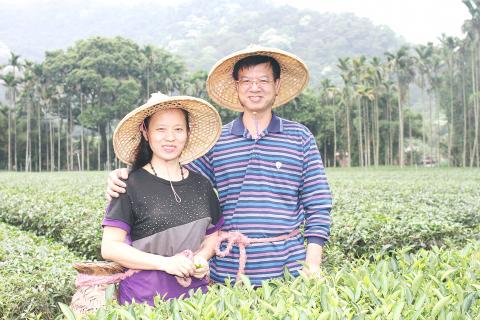
Tea farmer Huang Cheng-chung, right, and his wife pose for a picture in their tea plantation in New Taipei City’s Sansia on April 24.
Photo provided by the New Taipei City Government Agriculture Department
While tea is a popular drink, few people are familiar with the preparation of tea leaves before they are ready for brewing.
Huang Cheng-chung (黃正忠), 52, whose family has been growing tea for four generations in New Taipei City’s Sansia (三峽), has been helping out in the family’s tea factory since he was in junior-high school.
At the time, the nation’s economy was improving, and many helpers at the tea factory switched to the pottery industry in factories in nearby Yingge (鶯歌) because they offered better pay.
“Working at the pottery plant paid NT$30,000 per month,” Huang said, adding that wages at the tea factory were NT$6,000 per month.
With the lack of workers, everybody in the family who could see or smell was required to help out at the factory and the farm, Huang said.
Huang’s mother said that due to the lack of workers when other children were out playing, children in their family would help out in the tea fields.
However, Huang said he did not mind the work, adding that the experience had made him fall in love with tea planting.
“Any one element during the planting and processing, such as the timing of when the tea is picked, the temperature at which it is cured or the weather, can affect how the tea tastes when it is brewed,” Huang said.
Huang received his first plaque in 1993, when he was 31.
In those days, the Pinglin (坪林) tea farms had been the dominant force in tea production and were the prime award winners.
Sansia had never received an award before then, Huang said.
“When I entered the competition I pointed to the plaque and told the Pinglin Township mayor that I was going home with it,” Huang said with a laugh, adding that despite the official saying that such a feat was impossible, it now hangs on his wall.
Today, tea planting is more similar to cooking haute cuisine than agriculture, Huang said, adding that the farmer has to truly understand what customers want and make minute adjustments to all parts of the processing and planting procedures to ensure customer satisfaction.
Over the past four decades, Huang has received more than 10 “A+” commendations for his tea leaves, and he said he has developed his own path in terms of a tea farmer’s philosophy.
Huang received the title “King of Tea” in 1998 when he won the first Sansia Biluochun Evaluation Competition, and received the same title this year, making him the winner of six titles.
However, Huang is worried about the issues of the cross-strait service trade pact and the proposed free economic pilot zones.
The cross-strait service trade pact was signed in June last year to allow investment from both sides in certain industries.
The government also drafted an act to provide the legal basis for the establishment and operation of free economic pilot zones, that it hopes could serve as a test bed for liberalization that will facilitate the movement of personnel, goods and technology.
Critics have expressed concern that the proposed zones could become a back door enabling Chinese enterprises to enter Taiwan without restrictions.
Huang said that if the market is opened to China, there would be a massive influx of Chinese tea, which would be sold under the “Made in Taiwan” brand.
Chinese imports would compete with local tea markets and severely damage the nation’s tea trade, as the going price for Chinese tea per kilogram is one-fifth that of Taiwanese tea.
The mixed tea would not only divide the market of Taiwanese tea products, but would also damage the nation’s tea quality and reputation if it were exported overseas, Huang said, adding that over time Chinese tea would eventually replace Taiwanese tea as the main supply source on the international market.
The government needs to help the nation’s tea industry refine itself and ensure sustainable business models for local products, Huang said.
Huang said he did not understand how the government did not realize how the taxation system, which had been the main reason cheaper teas have been unable to survive before, worked to preserve the market value of locally produced tea.
If the market is flooded with mixed teas from China, local farmers will not be able to make a cent no matter hard they work, Huang said, adding that while the government relaxes its restrictions, it needs to listen to the opinions of local industries.
source: Taipei Times
|