|
Yuan nominees face tough questions
SECOND TERM? Opposition lawmakers questioned nine incumbent Examination Yuan members about their ‘poor’ attendance, moonlighting activities and KMT ties
By Alison Hsiao / Staff reporter
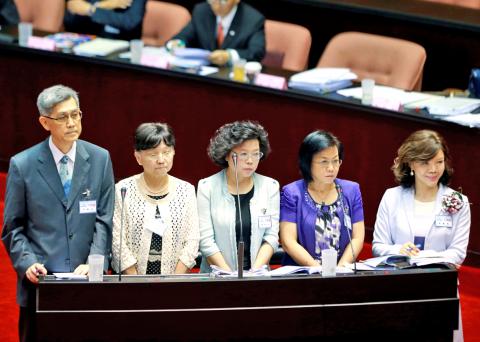
Examination Yuan member nominees yesterday answer questions as lawmakers review their qualifications.
Photo: Wang Yi-sung, Taipei Times
The Legislative Yuan yesterday began its two-day vetting of the 19 nominees for the Examination Yuan, starting with a review of the performance of nine members who will serve a second term if they pass the nomination process.
Democratic Progressive Party (DPP) lawmakers questioned the nine about their attendance in Examination Yuan meetings over the past six years — which one lawmaker described as “poor” — as well as their moonlighting activities.
“Only two of the total 19 nominees do not have income from being a teacher or holding other positions,” DPP Legislator Lee Chun-yi (李俊俋) said.
Lee added that many of the yuan’s members were absent more than 20 times during the last term.
Examination Yuan members need only take part in the yuan’s meeting every four weeks, but Lee Hsuan (李選) and Pasuya Poiconu (Pu Chung-cheng, 浦忠成) were absent 29 times, and Jan Chung-yuang (詹中原) was absent 25 times, the DPP lawmaker said, referring to three of the nine nominees.
Lee Chun-yi added that the Examination Yuan members earned an average of NT$500,000 a year from moonlighting, and none of them submitted more than 40 proposals during their six-year term.
Several of the nominees said they would quit their second job if their nomination is approved.
At least six of the nine nominees are KMT members, and three had worked for a KMT think tank, Lee Chun-yi said, asking how can they remain impartial.
Chao Li-yun (趙麗雲), a former KMT lawmaker, said that Examination Yuan members had not been involved in the KMT’s business since assuming their posts.
Lee Chun-yi countered that Examination Yuan Vice President Wu Jin-lin (伍錦霖), who has been nominated as president of the yuan, made the same pledge of impartiality six years ago.
“Despite his promise, [Wu] recently participated in one of Chien Tai-lang’s (簡太郎) campaign activities,” he said.
Chien is a minister without portfolio who is running for Pingtung County commissioner on the KMT ticket in the November elections.
Wu had defended his presence at the event, saying it was a Lunar New Year’s event and he did not go on stage to speak or canvass for votes.
Meanwhile, the Taiwan Solidarity Union (TSU) caucus, which declined to interview the nominees in protest against their nomination, held a press conference, questioning the nominees’ ties to the KMT.
TSU caucus whip Lai Cheng-chang (賴振昌) said that 12 of the 21 nominees for the Examination Yuan — including the president and vice president — have ties to the ruling party or had worked for President Ma Ying-jeou (馬英九).
For instance, Examination Yuan vice president nominee Kao Yuang-kuang (高永光), who has served as the head of the Referendum Review Committee, had rejected proposals for referendums on the Economic Cooperation Framework Agreement (ECFA), the return of the KMT’s ill-gotten wealth and Taiwan joining the UN, Lai said, adding that Kao’s repeated rejections have earned him the epithet “referendum killer.”
Meanwhile, KMT legislators Kung Wen-chi (孔文吉) and Lu Hsueh-chang (呂學樟) asked the nominees about their opinions on Academia Sinica research fellow Huang Kuo-chang (黃國昌) participating in the student-led Sunflower movement, and whether they thought Huang had violated the Civil Service Administrative Neutrality Act (公務人員行政中立法) and the Civil Service Act (公務員服務法).
The nominees were equivocal on the issue, emphasizing Huang’s duties as a civil servant and calling into question the appropriateness of his remarks, but adding that academics should be given room to participate and voice their opinions on public affairs.
Asked to comment on the Examination Yuan members’ answers, Huang said nominees who had worker for the KMT think tank as university professors should disclose their moonlighting income.
“No wonder the country is in such a mess. The [double] standards of these people say that it is okay to work for the KMT as a part-time job, but taking days off work to take part in a civil movement is absolutely a no-no.”
source: Taipei Times
|