|
Premier dodging responsibility: DPP
‘FALSEHOOD’: The DPP accused Jiang Yi-huah of trying to shift the responsibility on who ordered the violent crackdown on Sunflower protesters to his subordinates
By Chen Hui-ping, Chung Li-hua, Chen Yen-ting and Jake Chung / Staff reporters and staff writer, with CNA
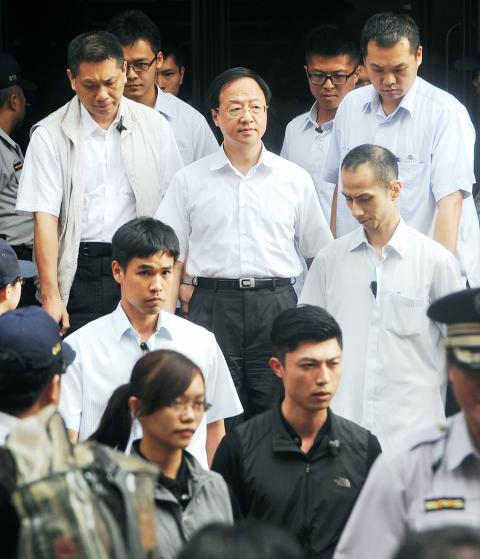
Premier Jiang Yi-huah on Wednesday leaves the Taipei District Court after being questioned about the handling of the Sunflower movement protests in March.
Photo: Liao Chen-huei, Taipei Times
The Democratic Progressive Party (DPP) yesterday accused Premier Jiang Yi-huah (江宜樺) of trying to shirk his responsibilities by denying that he ordered the violent eviction of protesters at the Executive Yuan compound in Taipei during the Sunflower movement in March.
A report published yesterday by the Chinese-language Apple Daily said that at a closed hearing on Wednesday, Jiang said that he “went to sleep at 1am and woke at 6am” on March 24.
“No one called me. I knew nothing of what happened during this time,” he said, according to the newspaper, which did not cite sources.
Jiang said that after he woke up, he telephoned National Police Agency Director-General Wang Cho-chiun (王卓鈞) asking if it was safe to go to work and Wang said yes, the report said.
However, at a press conference in March, Jiang said he had stayed up late that night watching live broadcasts of the protests on different TV news channels.
“That night I watched TV until really late into the night, changing [news] channels. I saw that most police officers carried out their duties as they were trained to do — pushing but not using their shields [against the protesters],” the premier said at the time.
Jiang, Wang, Taipei City Police Department Commissioner Huang Sheng-yung (黃昇勇) and Zhongzheng First Police Precinct Chief Fang Yang-ning (方仰寧) were summoned by the Taipei District Court on Wednesday for a closed hearing over their alleged involvement in the forced eviction of protesters, mainly students, who attempted to take over the Executive Yuan building.
DPP Legislator Lee Chun-yi (李俊俋) accused Jiang of lying at the hearing.
The lawmaker said he had asked Wang and Executive Yuan Secretary-General Lee Shu-chuan (李四川) during a legislative session on March 26 if it was Jiang who ordered the crackdown and Lee Shu-chuan gave an affirmative answer.
Wellington Koo (顧立雄), a member of the volunteer team of lawyers helping students who participated in the protests, said: “Jiang had admitted [at the hearing] to telling Huang: ‘I wish to see the Executive Yuan in order before I get to work tomorrow [March 24].’”
The Executive Yuan rebutted Koo’s comment, with Cabinet spokesman Sun Lih-chyun (孫立群) quoting Jiang as saying that Koo was “spreading falsehoods” and that the comment “was far from the truth.”
Sun said he could not comment further on the issue as the judge has declared the case a closed hearing.
Meanwhile, DPP spokesman Huang Di-ying (黃帝穎) accused Jiang of trying to shift the blame to his subordinates.
Huang Di-ying accused the premier of lying by saying that he knew nothing about what happened that night. He said Jiang did not have the courage to take responsibility for his own decisions.
Jiang was also letting the police officers who were at the site of the “bloody suppression” of the public to take the blame, he said.
Huang Di-ying said if the head of a gang had ordered an underling to “handle” something and it led to the underling injuring or killing others, the court would rule that the head of the gang was culpable because he was cognizant that the underling was armed and could cause injury or death when “handling” the issue.
Jiang knew that giving the police, who were armed, a deadline to remove the protesters could cause significant injuries to the activists, Huang Di-ying said.
“The law cannot have double standards, and Jiang should be held culpable for the incident,” he said.
The hearing showed that Jiang and Wang are gutless and liars, he said.
Both have been accused of attempted manslaughter and have tainted the nation’s civil service system, he said, adding that they should know when to step down.
Additional reorting by Shih Hsiu-chuan
source: Taipei Times
|