|
CPC pipelines illegal: legislator
SELF-INCRIMINATION? Legislator Kuan Bi-ling said that evidence CPC Corp, Taiwan provided showed that the company was improperly using its pipeline infrastructure
By Alison Hsiao / Staff reporter
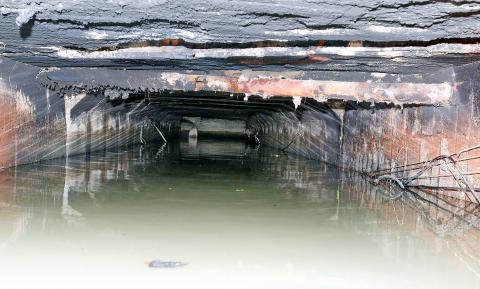
A water culvert in Greater Kaohsiung is pictured yesterday. Prosecutors examined a pipeline belonging to LCY Chemical Corp on Tuesday and found a hole that may be the cause of last week’s gas explosions in the municipality.
Photo: Chang Chung-yi, Taipei Times
Democratic Progressive Party (DPP) Legislator Kuan Bi-ling (管碧玲) accused CPC Corp, Taiwan (CPC, 台灣中油) of illegally laying pipelines to carry petrochemicals that were registered for carrying petroleum.
CPC made public earlier this week a document showing that of the 16 pipelines it helped to renew in 1990, only six belonged to it, while Taiwan Polypropylene Co Ltd (福聚) — which merged with LCY Chemical Corp (李長榮化工) in 2007 — owned one of the remaining 10 pipelines.
CPC displayed the document to refute LCY Chemical’s earlier accusation that CPC was responsible for safety inspections of the pipeline that has been found to have leaks and is suspected as the possible cause of the explosions last week in Greater Kaohsiung.
CPC said that the owner of each pipeline, LCY Chemical in this case, has sole responsibility for maintaining their infrastructure.
However, Kuan said that CPC’s document exposed flaws in the firm’s use of the pipelines.
While the document is about the renewal of “long-range petroleum pipelines,” 11 of the 16 pipelines documented, including two used by CPC, have been used to transport petrochemicals, Kuan said.
She said CPC’s pipeline installations in the area are illegal, citing the Rules for Enforcement of the Urban Planning Act in Kaohsiung City (都市計劃法高雄市施行細則) from 1989, which says the petrochemical industry is restricted to special industrial zones and is not to have its pipelines carrying hazardous materials through residential or commercial zones as designated by the local government.
An aide of Kuan, surnamed Chen (陳), said it is “highly unlikely” that the municipality’s Cianjhen (前鎮) and Lingya (苓雅) districts, where the explosions occurred, were once part of the special industrial zones.
“CPC also helped Formosa Plastics Group (FPG, 台塑集團) to build three pipelines [carrying petrochemical materials]. Why would CPC, FPG’s competitor, do such a thing? Clearly it was not up to the CPC, a state-run company, to make the decision. The Ministry of Economic Affairs should not evade the history of the municipality’s industrial structure or shun responsibility by claiming that it only has jurisdiction over petroleum and natural gas pipelines,” Kuan said.
Kuan also said that the ministry sponsored advertisements for the petrochemical industry in 2010, in which it asked where people could find waterproof umbrella cloth, toothpaste, toothbrushes or tires without the petrochemical industry.
“The ministry acted as the competent authority of the industry then, but now it tries to run as far as possible away from it,” Kuan said.
Meanwhile, the legitimacy of a drainage culvert that had three illegally installed pipelines is itself in doubt, with Water Resources Bureau Director Lee Hsien-yi (李賢義) saying the culvert cannot be found in the bureau’s records.
“We would never allow pipelines in the box culverts under our supervision,” Lee said, adding that the bureau is trying to find out which department built the culvert to determine whether its construction preceded the installation of the pipelines.
The Greater Kaohsiung District Prosecutors’ office said yesterday that the culvert along which the explosions occurred is not on its charts and is considering whether to dig up the culvert for closer examination.
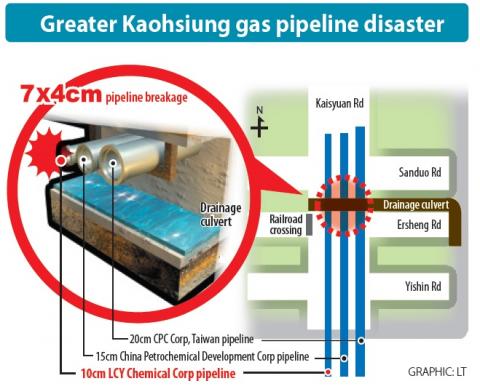
The office recently isolated the potential source of the explosion to a culvert at the intersection of Ersheng and Kaisyuan roads, confiscating a section of a heavily corroded pipeline used by LCY Chemical to store and deliver propene, the gas blamed for the explosions. Culverts should not have any pipelines attached to them, the office said.
A section of LCY Chemical’s pipeline that crossed an underground storm drain and had a hole apparently caused by corrosion was blamed for the leaking propene, according to the results of a preliminary investigation.
Meanwhile, Minister of Economic Affairs Chang Chia-juch (張家祝) said that he did not understand why the pipeline, which had been treated to resist corrosion underground, but not in the air, had been placed over a storm drain, which exposed it to the air.
Additional reporting by Jack Chung and CNA
source: Taipei Times
|